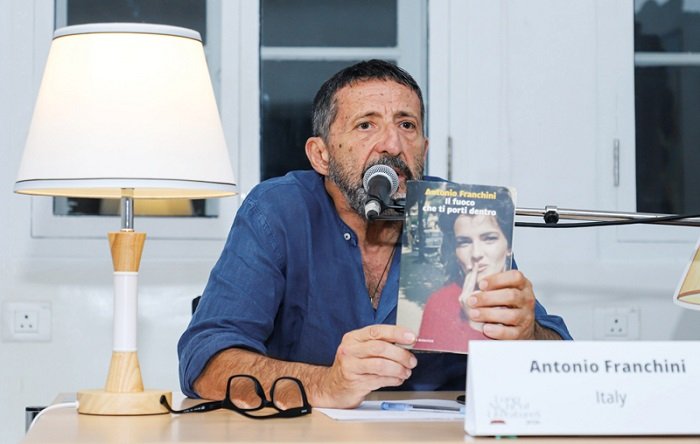
Priyanka Tanwar spoke with Italian author and veteran editorial director Antonio Franchini at the Long Night of Literatures 2026 in New Delhi on 23 October 2026. Drawing on decades of experience at major publishing houses such as Mondadori, Giunti, and Bompiani, where he helped take contemporary heavyweights such as Roberto Saviano and Paolo Giordano to global prominence, Franchini shares his perspective on the tension between corporate scale and independent writing, the rise of niche readership, and what it takes for Italian literature to cross borders.
Indian Printer & Publisher (IPP) – As the editorial director for heavyweights such as Bompiani and Giunti, how do you see historic Italian independent imprints protecting their literary identity against major corporate consolidation?
Antonio Franchini – It’s a very complex subject. I’ve worked my whole life at major companies, and I appreciate what independent publishers have done and continue to do. I think I have had the opportunity to publish significant literature as well, even in larger companies.
We have published the works of many important authors of contemporary Italian literature such as Roberto Saviano, Paolo Giordano, Margaret Mazzantini, Antonio Pennacchi and Alessandro D’Avenia in bigger companies. But even independent publishers need books that could sell well.
IPP – Is there a sustainable middle ground where independent narratives can still thrive alongside massive distribution networks?
Antonio Franchini – I think the challenge with literature is how to target its public well. This is possible even in small niches. Many small publishing companies can precisely identify their niche. But it is at times more difficult for bigger companies to identify their mass titles – because sometimes you can be lucky, but sometimes not. It is difficult to perfectly understand what the market requires.
IPP – The global English translation market is notoriously difficult to penetrate, yet projects such as the Seagull’s Italian list, have successfully bridged that gap. From a trade perspective, what is the biggest commercial hurdle for a contemporary Italian title trying to find traction in a complex market like India?
Antonio Franchini – When I started working in publishing, the market for Italian authors was much smaller compared to the market for Anglo-Saxon authors. Their fiction, in general, was much bigger than Italian fiction. Now the Italian market is stronger than the foreign market; for example, in non-fiction. Anglo-Saxon non-fiction is losing its share in the Italian market now. But for Italian authors, penetrating the foreign market is still difficult; I think in India as well. I don’t know how many Italian authors are popular in the Indian market, but I think very few.
IPP – Post-pandemic consumer habits have shifted worldwide, altering traditional supply chains. How is the Italian book market balancing the rising cost of physical print manufacturing against the growing demand for digital and audio publishing?
Antonio Franchini – The digital market in Italy is still very small. It’s around 4-5% of the global share. Small because Italy is not a country of readers. The digital market share is strong in countries with a strong readership because they often buy both the print and the digital versions.
It is difficult to say what will happen in the future in Italy. But I don’t think digital is going to get any bigger in the next five years.
Audio publishing in Italy is growing a little because readers are listening to podcasts. But we are not a country of commuters because Italy is a small nation. Yes, there are people traveling to reach their workplace, but it’s not as widespread as in bigger countries such as the United States or India.
IPP – You balance a rare perspective as both an academic creative author and a senior corporate editor. How do you successfully detach your critical editing eye when trying to find your own authentic entry point into a story?
Antonio Franchini – No, I am completely another person when I write myself. I worked all my life for big commercial companies. So, I developed a taste for mass titles. But when I write for myself, I have not changed my taste. Being a universal reader is challenging – separating what you are and what you deeply like from what you like for the job.
IPP – In your lecture at the Italian Cultural Institute, you spoke about finding the exact words needed to enter a narrative. Are changing global anxieties and hyper-digitalization forcing contemporary Italian authors to structurally rewrite how they open their books?
Antonio Franchini – I think there is a new sensibility in Italian writers to try to reach their public. For example, Giuseppe Pontiggia was a refined literary author, but he was also capable of being very direct. This is the kind of literature I particularly like, but it’s my personal taste.
IPP – When reviewing manuscripts for Giunti or Bompiani, what is the single most common mistake modern writers make when trying to capture a reader’s attention in the first few pages?
Antonio Franchini – This is a very difficult question. Even if I read all the time, pointing out a specific mistake isn’t easy. It’s difficult because in any case, you have to judge a work in its complexity, not only by the beginning, which even if it’s insipid is very important. I prefer judging the book as a whole.
IPP – In trade publishing, tactile elements influence a consumer’s purchasing decisions. How much weight do Italian publishers place on specialized typography, effects and coatings, and premium cover stock when branding a new release?
Antonio Franchini – I think that in Italy, even though our market is small, there has always been a lot of sensitivity toward the physical aspect of the book – the typography and the embossing. Our editions are very accurate, and we have good cover designers. Obviously, the Anglo-Saxon market is more advanced than ours, but ours is one of the best in Europe, from the typographical and graphic point of view.
IPP – Which contemporary Italian voice or hidden gem should an independent literary publisher translate next for the South Asian market?
Antonio Franchini – Utopia Editore is a new independent publishing company that does important work on the literary side with authors who are not published any more. Past authors of the last century who were important in Italian literature but not printed anymore. They published the winner of the last Nobel Prize (Eugenio Montale).