When Adobe introduced the current version of its Adobe PDF Print Engine, there was also a suggestion of further features to come under an Adobe Print Services umbrella, and this has now been fully launched into the market.
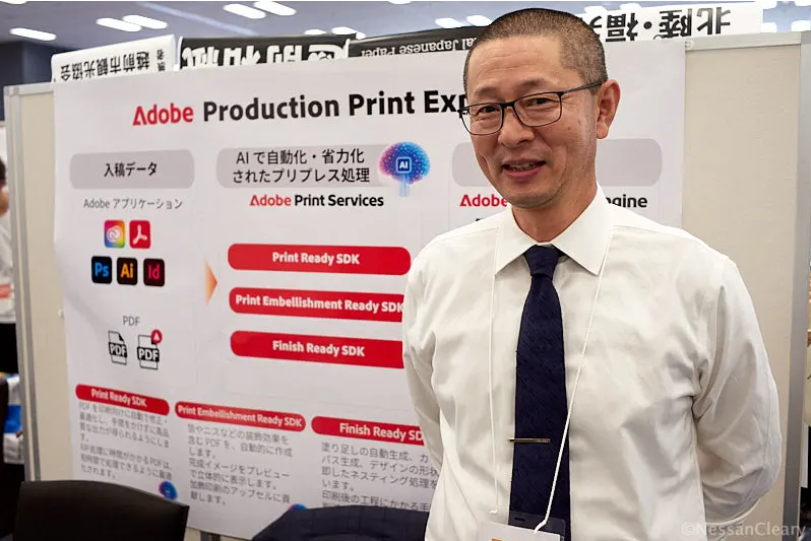
Adobe Print Services is made up of three parts – Print Ready, Print Embellishment Ready and Finish Ready – which are each sold in the form of a Software Development Kit or SDK and mainly aimed at printer OEMs. They all rely heavily on Adobe’s own embedded artificial intelligence or AI technology.
Adobe has been working on these SDKs for at least the last five years and tested them with many of its printer OEMs. I caught up with Shigera Masuda, senior OEM project manager for Adobe Japan, at this year’s Japan Inkjet Technology Fair, who told me, “We have upgraded them many times based on this feedback, so now we are ready to productize them.”
Each of the three parts is aimed at specific areas. Thus the Print Ready SDK is about ensuring that PDFs are ready to print. Masuda explains, “What is important is to solve problems in the wild. The use of online platforms and even AI chatbots is increasing and there are many non-professional PDFs that require some changes.” He says that some online design platforms and chatbots do not understand issues like fonts or color management, let alone PDF specifications for printing.
So the Print Ready SDK can be used to correct common issues such as missing fonts, low resolution images and colour issues. Masuda says that this differs from preflighting software, which is mainly aimed at correcting the structure of a PDF to comply with printing specifications. He adds, “But with Print Ready we remove issues in order to create a good printing experience so it’s more focused and faster.” Much of the underlying technology comes from Photoshop, including the ability to upscale the resolution in images.
As such it could in theory be used to replace existing preflighting software. However, many of the file changes would require confirmation by an operator, whereas many preflight programs have a degree of automation, which is needed for any printshop handling large numbers of low margin short run jobs to prevent the preflighting itself becoming a production bottleneck. Then again, such automation requires confidence in the results, with one workflow developer pointing out to me that AI-driven results can sometimes be a little unpredictable. That said, APS is still at v1 and it’s the nature of AI that as more data is added over time, so the results will improve so I would expect some options for automation to appear in future versions.
Then there is the Print Embellishment Ready SDK. Masuda says that it’s challenging to create PDFs with gold, silver and varnish embellishments and that most OEMs have had to put their own solution together. The Print Embellishment Ready SDK picks up whatever devices are available on a network to determine which embellishments to make use of. It can add the effects to the PDF for printers that offer additional channels or it can create a separate PDF if there is a standalone embellishment device such as an MGI or Scodix press available.
The Print Embellishment Ready SDK also goes a step further as it can allow printshops to suggest embellishments that could be added to a design file, with samples for the customers to accept or change these recommendations. It makes use of some embedded large language AI capability to understand natural language queries and accept prompts for designs. The idea here is to help print shops upsell these embellishment features, which customers might not otherwise think of asking for. And of course, giving such capability to a print service provider also makes it more likely that they will invest in such hardware.
The final part, the Finish Ready SDK, is mainly for adding cut lines, bleed and nesting. For bleed, Adobe has borrowed from its Photoshop technology to automatically analyze objects at the edges of an image to create bleed. This is more than just duplicating pixels around the edges as the system can understand vector graphics and textured effects to genuinely predict how the shape of an object will continue beyond its edge. Masuda notes, “Photoshop has a great deal of embedded AI technology so we can use this for printing.”
Adobe has patented new technology to create nesting, where multiple objects are automatically placed around each other. Masuda says the aim is to reduce the unnecessary space between objects as much as possible and therefore any media wasted when those objects are cut out, noting: “It can identify very complicated patterns and which kind of combination is better for each substrate to make the object closer to reduce substrate use even with very irregular shapes.”
Customers are free to use all three of the APS SDKs together, or just to pick the individual parts they need. It’s also possible to use any of the APS parts with other non-Adobe RIPs but there is some benefit to using the APS SDKs with the Adobe PDF Print Engine as tighter integration allows for faster analysis of the PDF structure.
Some OEMs have already announced solutions based on the Adobe Print Services SDKs. This includes Eco3, which develops the Apogee workflow, and which was one of the first workflows to use APPE. Konica Minolta offers the Embellishment Forge, while Xerox is selling the Empres Studio – both of which mainly use the Print Embellishment features. The Adobe Print Services SDKs are available now to OEMs, with further details from adobe.com.